Two backpacks can look identical on a product photo and behave nothing alike after a year of daily carry. The difference is almost always the fabric, and the fabric is usually described with a single number: 600D, 900D, 1680D. That number is useful, but it is also the most misread spec in the whole category. If you are ordering custom packs in bulk, understanding what denier does and does not tell you is the fastest way to avoid a warranty problem six months after delivery. This is a working guide to backpack fabrics, the coatings layered onto them, and how to write a spec that gets you the pack you actually pictured.
What denier actually measures
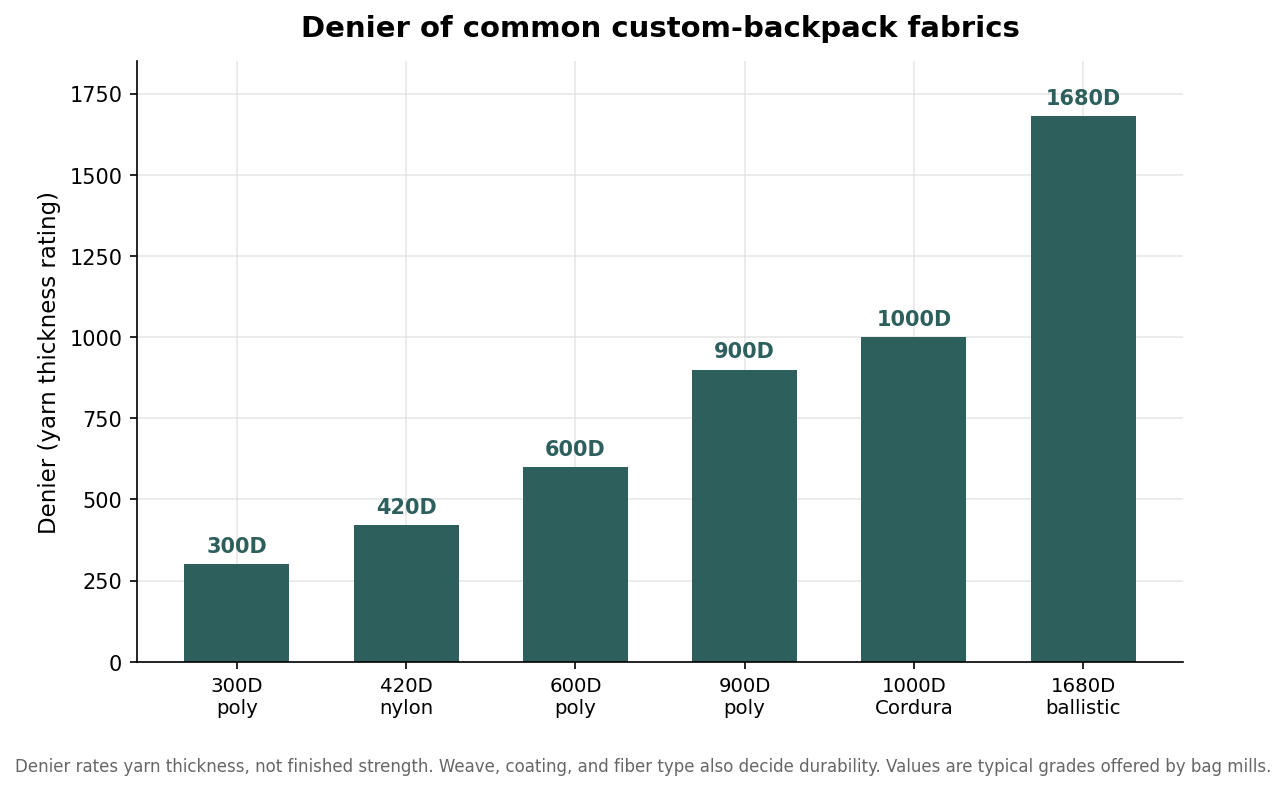
Denier is a measure of yarn thickness, not finished toughness. Technically it is the weight in grams of 9,000 meters of a single yarn, so a higher number means a heavier, thicker thread. A 1680D yarn is roughly twice as thick as a 600D yarn, which is why 1680D ballistic fabrics feel substantial and shrug off scrapes. But denier says nothing directly about how tightly the fabric is woven, what fiber it is made from, or what coating sits on the back, and all three of those change durability as much as thread thickness does. A tightly woven 600D can outlast a loosely woven 900D in real use. Treat denier as a helpful shorthand for weight and abrasion resistance, not as a durability score you can rank on its own.
The common deniers, from 300D to 1680D
Most custom backpack programs land somewhere on a familiar ladder. Light daily and promotional packs use 300D to 420D fabric, which keeps weight and cost down for bags that will not see hard duty. The workhorse of the category is 600D polyester: it has decent abrasion resistance, takes print and embroidery well, and suits school, commuter, and event packs. Step up to 900D for outdoor, sports, and travel bags that need more scuff resistance, and to 1000D Cordura or 1680D ballistic nylon for heavy-duty, rugged travel, or tactical builds where the fabric is expected to take real abuse. The trade-off running up that ladder is weight and price: every jump in denier adds grams to the empty bag and cents to the unit cost, so the goal is to match the fabric to the duty cycle rather than to over-build by reflex.
Nylon or polyester at the same denier
Fiber type matters as much as the number. At the same denier, nylon is generally stronger and more abrasion-resistant than polyester, which is why the toughest packs specify ballistic nylon or Cordura rather than high-denier poly. Polyester, on the other hand, holds color better under sunlight, resists UV fading, and usually costs less, which makes 600D polyester the sensible default for branded and event bags that live indoors and need crisp, lasting logo color. There is also a growing recycled-polyester option: some packs now use a 600D body spun from post-consumer bottles, with one recycled-poly model reclaiming on the order of sixteen half-liter bottles per bag. If a client cares about a sustainability story to go with their logo, recycled poly gives you one without a meaningful drop in everyday performance.
Why the coating decides wet-weather performance
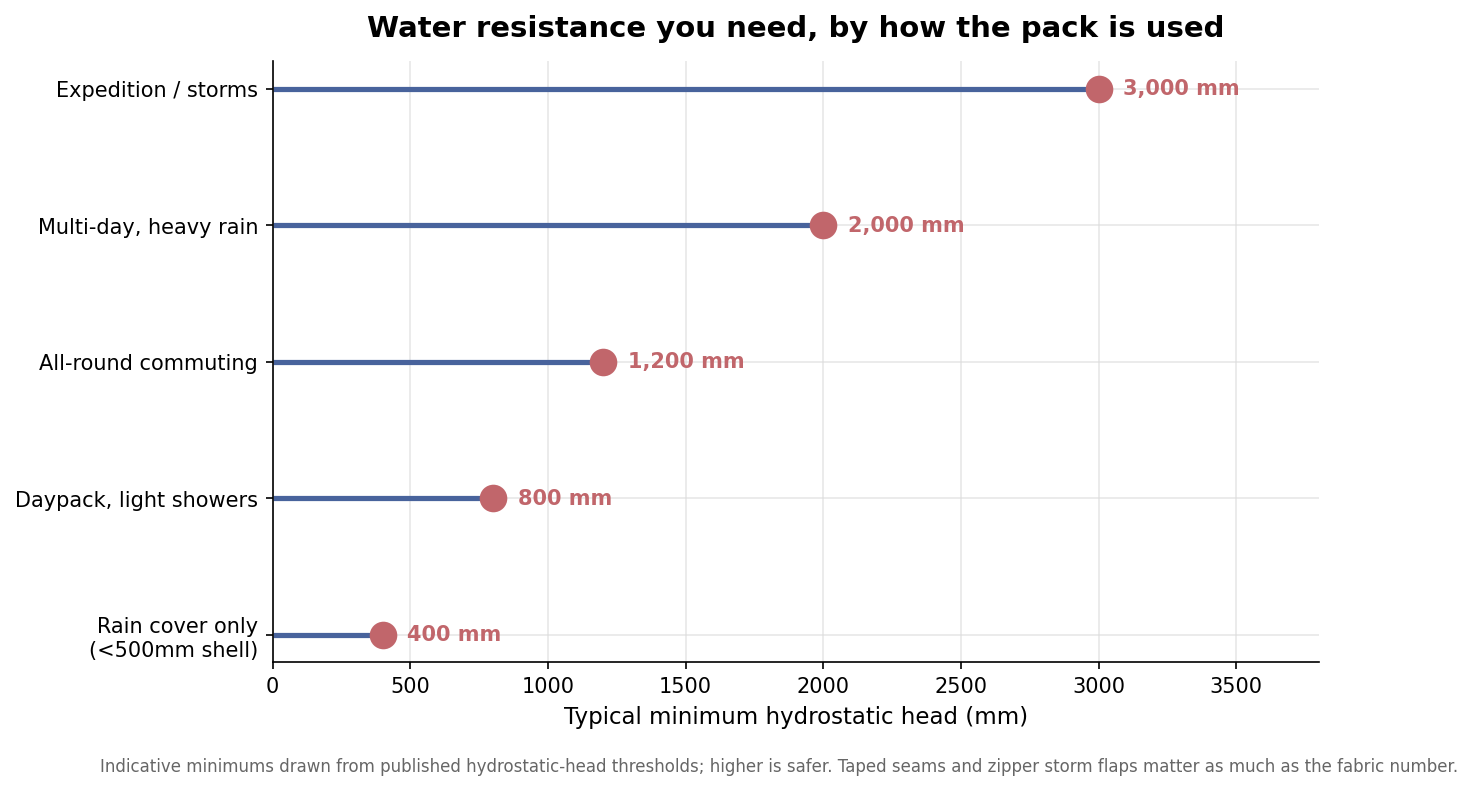
Denier gets the attention, but whether a pack keeps a laptop dry comes down to the coating and the construction, not the thread. Fabric water resistance is measured as hydrostatic head, the height in millimeters of a water column the fabric holds back before it leaks. Below about 500mm a fabric handles only mist, 500 to 1000mm covers light rain and short showers, 1000 to 1500mm suits most everyday outdoor use, and 1500 to 2500mm is the range for heavy, sustained rain. Coatings are how you get there: a DWR finish makes water bead off the surface but wears away and needs reproofing, while a PU coating on the fabric back is the cost-effective waterproof workhorse, with TPU and silicone offering more durability at a higher price. Just as important, water gets in through needle holes and zippers long before it soaks through good fabric, so taped seams and a storm flap over the zippers often matter more than the last few hundred millimeters of rating.
Specifying fabric for a custom bulk order
Turn all of this into a spec by starting from how the bag will live, then choosing fabric, fiber, and coating to match. For an indoor branded or event pack, 600D polyester with a light PU coating and clean logo color is usually the right and most economical answer. For a commuter or laptop bag, hold the same 600D but insist on a genuine PU coating in the roughly 1000 to 1500mm range plus a padded, suspended laptop sleeve and, ideally, taped seams over the main compartment. For rugged travel or field use, move up to 1000D Cordura or 1680D ballistic nylon and accept the added weight and cost as the price of longevity. Whatever you choose, write the fabric, the fiber, the coating type, the hydrostatic head, and the seam treatment into the spec explicitly rather than trusting a lone denier number, and order a pre-production sample to confirm the hand, the color, and the coating before the full run. At Get Custom Backpacks the minimum order is 12 backpacks and standard turnaround is about 2 weeks from mockup approval; confirm dates in writing before you lock a delivery date.